Key Stage 3
Pupils in KS3 are offered a broad and balanced, knowledge-rich curriculum. This is a curriculum focused on the acquisition powerful knowledge, coupled with rigorous and meaningful assessment. Key features of our KS3 curriculum include:
Building Knowledge
Knowledge underpins all learning and developing a knowledge-rich curriculum is at the heart of our curriculum development. All subjects have identified the core content and knowledge that pupils are expected to learn and understand in order to move to the next stage of their development. Resources have been produced organically by subject experts and all pupils in KS3 receive a booklet, knowledge organiser and glossary to support knowledge acquisition.
We have high expectations for all groups of learners and there is no reduced curriculum at Bishop Walsh. However, we recognise the need for adaptive teaching where necessary so that all pupils have the opportunity to experience success.
Reading
In order to fully access the curriculum, pupils need to be able to read to at least their chronological age. We therefore understand that there is a deepening recognition of the fundamental importance of improving reading standards on a child’s academic achievement, wellbeing and success in life.
At KS3, all subjects explicitly teach new vocabulary and pupils are expected to apply this vocabulary in their work. To ensure that all pupils are academically literate and are able to read at a level that is at least in line with their age, our strategies include:
· Using reading tests to identify the weakest readers in each cohort and then design appropriate intervention;
· Enrolling pupils who need reading support into book club to develop reader confidence via modelling by an expert reader;
· Promoting reading for pleasure in our reading room to help develop a lifelong love for reading.
Disciplinary Literacy
Disciplinary literacy is an approach to improving literacy across the curriculum. Combined with the reading strategies above, disciplinary literacy recognises that literacy skills in a secondary school are both general and subject specific. Strategies to develop and improve disciplinary literacy include:
· Promoting disciplinary literacy across the KS3 curriculum;
· Providing targeted vocabulary instruction in every subject by developing and modelling tier 2 and tier 3 vocabulary;
· Developing pupils’ ability to read and access academic texts by predicting, questioning, clarifying and summarising;
· Breaking down complex writing tasks by modelling and scaffolding to enable pupils to monitor and review their own writing;
· Combining reading and writing by using the teacher as the expert reader and to model methods such as annotating and summarising texts;
· Provided opportunities for structured talk by developing oracy through the use of: Say it again, better and teachers modelling what effective talk sounds like in their subject.
Cultural Capital
At Bishop Walsh, we want to equip pupils with the knowledge and cultural capital they need to succeed in life. The most obvious way to ensure this is through our curriculum, which is knowledge-rich and ambitious for all groups of learners. Our KS3 curriculum is brad and balanced so that pupils achieve well and are ready for the next stage in their education.
Cultural capital is crucial to pupils’ development, not only in their academic success but also in their ability to contribute to the wider community and for their quality of life. Our curriculum will therefore explicitly teach the shared, powerful knowledge needed to progress in life through our curriculum choices, SAINT programme, careers programme and extra-curricular activities.
The Timetable
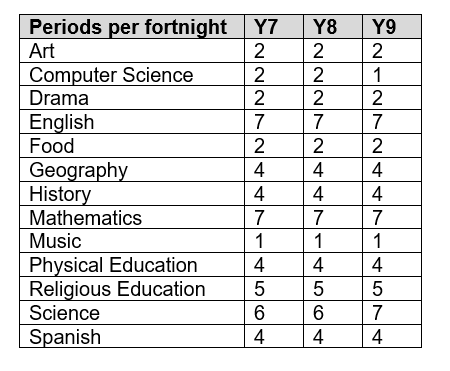
We offer a 50-period, two-week timetable – 25 periods in Week A and 25 periods in Week B. There are five lesson per day and each lesson lasts for one hour.